Untitled (1969)
Adrian HeathAdrian Heath’s Untitled is an oil painting exploring abstraction through the interplay of form, colour, and texture. A prominent figure in British post-war abstract art, Heath frequently juxtaposed organic and geometric elements to create works that evoke both movement and equilibrium.
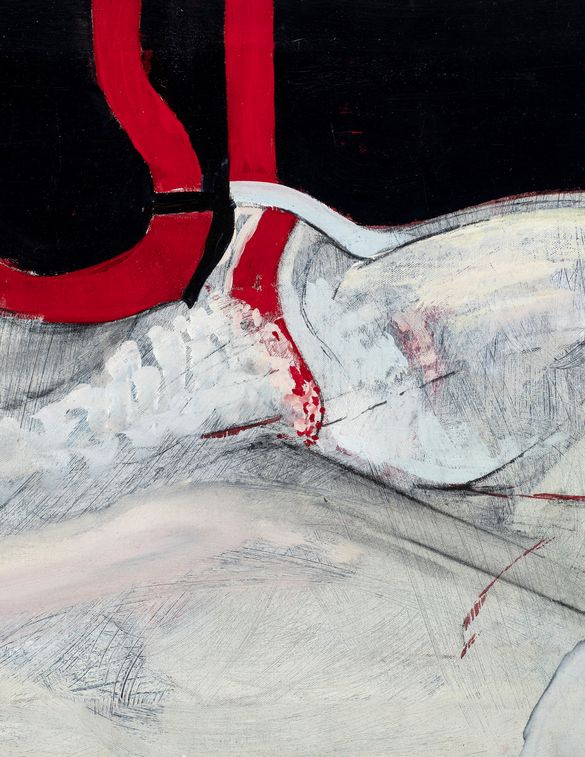
In this composition, a deep black background contrasts sharply with the light tones of the foreground, where white and grey dominate. Broad, sweeping brushstrokes introduce a sense of dynamism and depth, while vivid red forms punctuate the composition, adding intensity and visual rhythm. The curving red lines intersect and connect the surrounding shapes, guiding the viewer’s gaze and creating a tension between cohesion and fragmentation. Delicate linear markings within the softer areas of the painting provide intricate details, balancing the bolder, more assertive strokes.
The forms are intentionally ambiguous, inviting open interpretation. While the composition suggests references to the corporeal or natural landscapes, its abstract nature allows the viewer to engage on an emotional and intellectual level. The bold contrasts and layered textures evoke themes of tension and harmony, structure and spontaneity, offering a nuanced visual experience.
Heath’s skill lies in his ability to balance dynamic gestures with carefully considered compositional intent. The interplay of bold, assertive colours and subtle, textured layers reflects his interest in exploring the material qualities of paint while challenging traditional notions of representation. This painting exemplifies Heath’s innovative approach to abstraction and his ability to evoke a profound response through the language of colour, form, and movement.
Adrian Heath’s Untitled is an oil painting exploring abstraction through the interplay of form, colour, and texture. A prominent figure in British post-war abstract art, Heath frequently juxtaposed organic and geometric elements to create works that evoke both movement and equilibrium.
In this composition, a deep black background contrasts sharply with the light tones of the foreground, where white and grey dominate. Broad, sweeping brushstrokes introduce a sense of dynamism and depth, while vivid red forms punctuate the composition, adding intensity and visual rhythm. The curving red lines intersect and connect the surrounding shapes, guiding the viewer’s gaze and creating a tension between cohesion and fragmentation. Delicate linear markings within the softer areas of the painting provide intricate details, balancing the bolder, more assertive strokes.
The forms are intentionally ambiguous, inviting open interpretation. While the composition suggests references to the corporeal or natural landscapes, its abstract nature allows the viewer to engage on an emotional and intellectual level. The bold contrasts and layered textures evoke themes of tension and harmony, structure and spontaneity, offering a nuanced visual experience.
Heath’s skill lies in his ability to balance dynamic gestures with carefully considered compositional intent. The interplay of bold, assertive colours and subtle, textured layers reflects his interest in exploring the material qualities of paint while challenging traditional notions of representation. This painting exemplifies Heath’s innovative approach to abstraction and his ability to evoke a profound response through the language of colour, form, and movement.
Camden Art Collection
The London Borough of Camden Art Collection consists of just under 1,000 items that include works on paper, paintings and sculptures. The main focus of the collection is works dating from the late 1950s to the late 1980s, with many pieces by artists who lived in the Borough. Many of these works were inherited from the predecessor authorities who were gifted these pieces when the Council was established in 1965. Other works were directly purchased by the Council from 1965 to 1985, with limited funding from a ‘picture loan’ scheme that the Council operated.
Supporters