Silver Olympic Poster
Shusaku ArakawaShusaku Arakawa’s Silver Olympic Poster (1972) was created as part of the poster series commissioned for the 1972 Summer Olympics in Munich. A conceptual artist with a background in architecture and philosophy, Arakawa brought his innovative approach to this project, combining design, motion, and abstraction to encapsulate the energy and universality of the Olympic Games.
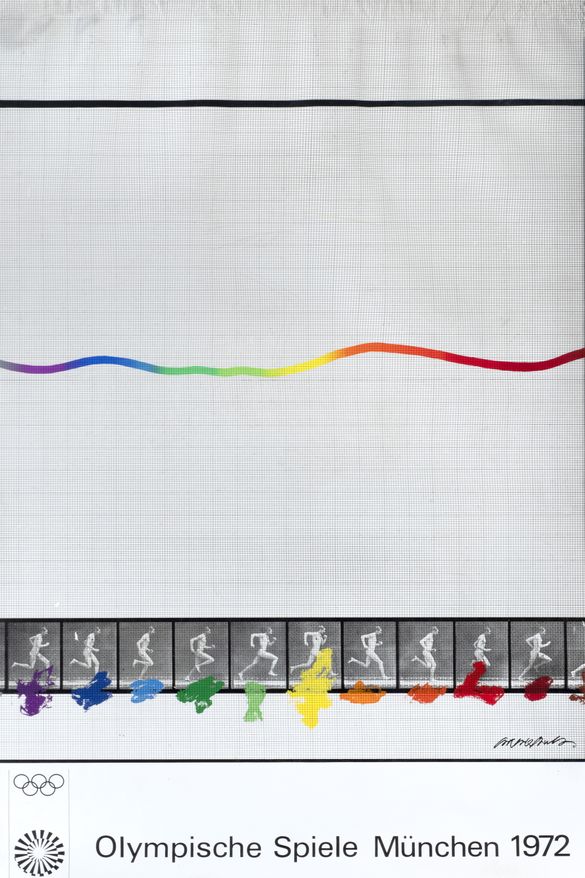
The composition features a grid-like structure, a motif often seen in Arakawa’s work. Within the grid, a series of photographic frames depicts an unclothed runner mid-stride, capturing a sequence of movement with an emphasis on the human form in its purest state. Beneath each frame, vivid splashes of colour—purple, blue, green, yellow, orange, and red—extend the runner’s motion into an energetic expression of the Olympic spirit. Above the sequence, a single wavy line transitions through the same spectrum of colours, echoing the sense of motion and unifying the composition with a rhythmic flow. A bold black horizontal line above these elements introduces a sense of structure and balance, framing the composition and anchoring the interplay of colour and movement within the grid.
The stark black-and-white imagery of the runner contrasts with the fluid and vibrant colours, creating a visual dialogue between structure and freedom, discipline and creativity. The unclothed figure highlights the classical ideals of athleticism and human potential, connecting the modern Olympic Games to their ancient origins. This interplay reflects the dual essence of the Olympics, where intense preparation converges with the joyous celebration of human capability and achievement. The inclusion of the official Olympic emblem and the text “Olympische Spiele München 1972” grounds the work in its historical and promotional context.
Arakawa’s Silver Olympic Poster embodies the fusion of art and sport that defined the 1972 Games. Now part of the Camden’s People’s Museum collection, this poster stands as a lasting testament to the power of art to celebrate global unity and physical achievement.
Shusaku Arakawa’s Silver Olympic Poster (1972) was created as part of the poster series commissioned for the 1972 Summer Olympics in Munich. A conceptual artist with a background in architecture and philosophy, Arakawa brought his innovative approach to this project, combining design, motion, and abstraction to encapsulate the energy and universality of the Olympic Games.
The composition features a grid-like structure, a motif often seen in Arakawa’s work. Within the grid, a series of photographic frames depicts an unclothed runner mid-stride, capturing a sequence of movement with an emphasis on the human form in its purest state. Beneath each frame, vivid splashes of colour—purple, blue, green, yellow, orange, and red—extend the runner’s motion into an energetic expression of the Olympic spirit. Above the sequence, a single wavy line transitions through the same spectrum of colours, echoing the sense of motion and unifying the composition with a rhythmic flow. A bold black horizontal line above these elements introduces a sense of structure and balance, framing the composition and anchoring the interplay of colour and movement within the grid.
The stark black-and-white imagery of the runner contrasts with the fluid and vibrant colours, creating a visual dialogue between structure and freedom, discipline and creativity. The unclothed figure highlights the classical ideals of athleticism and human potential, connecting the modern Olympic Games to their ancient origins. This interplay reflects the dual essence of the Olympics, where intense preparation converges with the joyous celebration of human capability and achievement. The inclusion of the official Olympic emblem and the text “Olympische Spiele München 1972” grounds the work in its historical and promotional context.
Arakawa’s Silver Olympic Poster embodies the fusion of art and sport that defined the 1972 Games. Now part of the Camden’s People’s Museum collection, this poster stands as a lasting testament to the power of art to celebrate global unity and physical achievement.
Camden Art Collection

The London Borough of Camden Art Collection consists of just under 1,000 items that include works on paper, paintings and sculptures. The main focus of the collection is works dating from the late 1950s to the late 1980s, with many pieces by artists who lived in the Borough. Many of these works were inherited from the predecessor authorities who were gifted these pieces when the Council was established in 1965. Other works were directly purchased by the Council from 1965 to 1985, with limited funding from a ‘picture loan’ scheme that the Council operated.
Supporters