Legende vom Toten Soldaten
Peter de FranciaPeter de Francia’s Legende vom Toten Soldaten (translated as Legend of the Dead Soldier) is a powerful work that critiques the absurdities of war and the rituals surrounding it. The artwork draws inspiration from Bertolt Brecht’s satirical poem of the same name, which highlights the tragic futility of militarism and its effects on society.
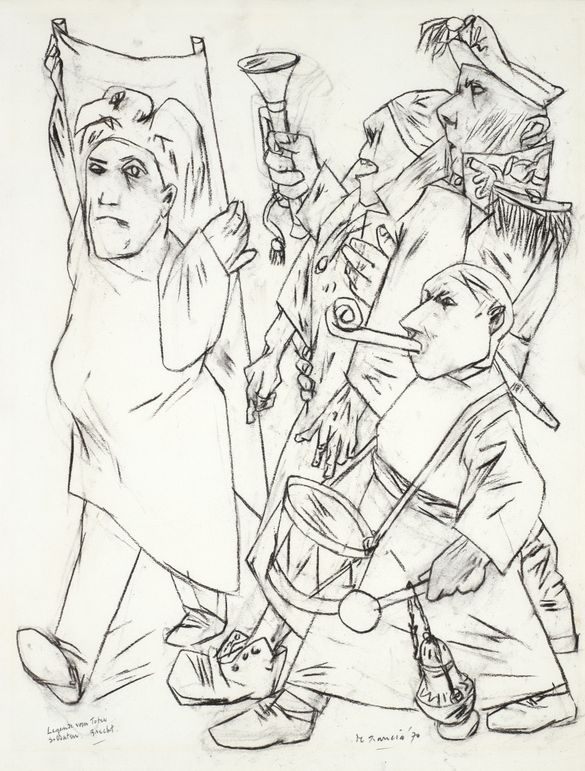
The drawing depicts a procession of figures, each carrying symbolic objects associated with war and authority. A banner-bearer leads the march, holding an ominous flag that suggests an unrelenting adherence to tradition. Behind them, a figure carries a trumpet, and another plays a drum, evoking a military funeral or ceremonial march. These characters are caricatured, their exaggerated features underscoring the mechanical and detached nature of their roles.
Rendered in pencil and charcoal, the composition emphasises sharp lines and contrasts, which create a dynamic sense of movement within the procession. The figures, though stylised, appear weighed down by the gravity of their actions, highlighting the dehumanising impact of their symbolic roles. De Francia’s use of bold, angular lines imbues the work with an intense energy, reflecting the tension between individual identity and collective behaviour.
The English title, Legend of the Dead Soldier, underscores the tragic irony of the scene. The work invites viewers to reflect on the persistence of war’s narratives and the societal structures that perpetuate them. By invoking Brecht’s critique, de Francia situates his drawing within a broader tradition of socially conscious art, using his medium to question systems of power and the stories we tell about conflict.
This drawing, with its potent blend of satire and social commentary, remains a thought-provoking piece in the Camden’s People’s Museum collection, encouraging reflection on themes of war, tradition, and collective memory.
Peter de Francia’s Legende vom Toten Soldaten (translated as Legend of the Dead Soldier) is a powerful work that critiques the absurdities of war and the rituals surrounding it. The artwork draws inspiration from Bertolt Brecht’s satirical poem of the same name, which highlights the tragic futility of militarism and its effects on society.
The drawing depicts a procession of figures, each carrying symbolic objects associated with war and authority. A banner-bearer leads the march, holding an ominous flag that suggests an unrelenting adherence to tradition. Behind them, a figure carries a trumpet, and another plays a drum, evoking a military funeral or ceremonial march. These characters are caricatured, their exaggerated features underscoring the mechanical and detached nature of their roles.
Rendered in pencil and charcoal, the composition emphasises sharp lines and contrasts, which create a dynamic sense of movement within the procession. The figures, though stylised, appear weighed down by the gravity of their actions, highlighting the dehumanising impact of their symbolic roles. De Francia’s use of bold, angular lines imbues the work with an intense energy, reflecting the tension between individual identity and collective behaviour.
The English title, Legend of the Dead Soldier, underscores the tragic irony of the scene. The work invites viewers to reflect on the persistence of war’s narratives and the societal structures that perpetuate them. By invoking Brecht’s critique, de Francia situates his drawing within a broader tradition of socially conscious art, using his medium to question systems of power and the stories we tell about conflict.
This drawing, with its potent blend of satire and social commentary, remains a thought-provoking piece in the Camden’s People’s Museum collection, encouraging reflection on themes of war, tradition, and collective memory.
Camden Art Collection
The London Borough of Camden Art Collection consists of just under 1,000 items that include works on paper, paintings and sculptures. The main focus of the collection is works dating from the late 1950s to the late 1980s, with many pieces by artists who lived in the Borough. Many of these works were inherited from the predecessor authorities who were gifted these pieces when the Council was established in 1965. Other works were directly purchased by the Council from 1965 to 1985, with limited funding from a ‘picture loan’ scheme that the Council operated.
Supporters