Hop Alleys
William TownsendHop Alleys by William Townsend is a compelling ink drawing that captures the linear rhythm and architectural form of hop fields. Created with meticulous black ink lines on paper, this piece presents a symmetrical, almost abstract perspective of a hop field, where rows of tall poles and overhead wires converge into a vanishing point on the horizon. The sparse, monochromatic composition emphasises Townsend’s focus on structure and perspective, transforming the agricultural landscape into a study of line, depth, and space.
Townsend employs a dynamic use of line to convey the organised yet complex layout of the hop fields, where plants climb vertically along wires stretching between poles. The drawing’s stark black lines crisscross the composition, creating an intricate web that draws the viewer’s eye along the rows and into the distant landscape. This linear arrangement not only accentuates the geometry of the hop field but also captures a sense of order and discipline associated with agricultural labour.
The minimal shading and absence of colour shift the viewer’s attention to the spatial relationships between elements in the landscape, with Townsend’s lines creating depth and movement across the field. This approach evokes a quiet atmosphere, allowing the viewer to contemplate the subtle beauty of the industrialised natural world. Townsend’s drawing embodies themes of rural labour and the human influence on nature, inviting reflection on the intersection of industry and landscape.
Hop Alleys stands as a testament to Townsend’s ability to find beauty in the structural aspects of everyday life, capturing the rhythm and resilience of rural England through a simple, striking composition.
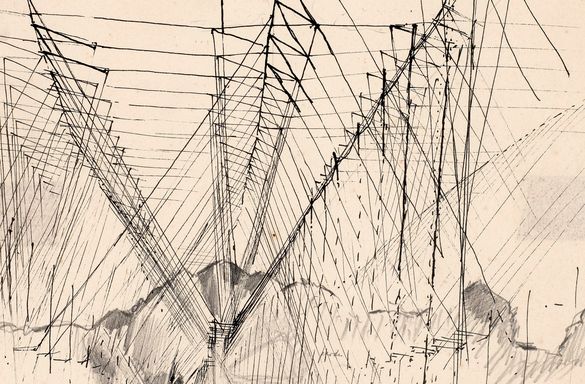
Hop Alleys by William Townsend is a compelling ink drawing that captures the linear rhythm and architectural form of hop fields. Created with meticulous black ink lines on paper, this piece presents a symmetrical, almost abstract perspective of a hop field, where rows of tall poles and overhead wires converge into a vanishing point on the horizon. The sparse, monochromatic composition emphasises Townsend’s focus on structure and perspective, transforming the agricultural landscape into a study of line, depth, and space.
Townsend employs a dynamic use of line to convey the organised yet complex layout of the hop fields, where plants climb vertically along wires stretching between poles. The drawing’s stark black lines crisscross the composition, creating an intricate web that draws the viewer’s eye along the rows and into the distant landscape. This linear arrangement not only accentuates the geometry of the hop field but also captures a sense of order and discipline associated with agricultural labour.
The minimal shading and absence of colour shift the viewer’s attention to the spatial relationships between elements in the landscape, with Townsend’s lines creating depth and movement across the field. This approach evokes a quiet atmosphere, allowing the viewer to contemplate the subtle beauty of the industrialised natural world. Townsend’s drawing embodies themes of rural labour and the human influence on nature, inviting reflection on the intersection of industry and landscape.
Hop Alleys stands as a testament to Townsend’s ability to find beauty in the structural aspects of everyday life, capturing the rhythm and resilience of rural England through a simple, striking composition.
Camden Art Collection
The London Borough of Camden Art Collection consists of just under 1,000 items that include works on paper, paintings and sculptures. The main focus of the collection is works dating from the late 1950s to the late 1980s, with many pieces by artists who lived in the Borough. Many of these works were inherited from the predecessor authorities who were gifted these pieces when the Council was established in 1965. Other works were directly purchased by the Council from 1965 to 1985, with limited funding from a ‘picture loan’ scheme that the Council operated.
Supporters