French Shop
David HockneyFrench Shop by David Hockney is a finely detailed etching that demonstrates the artist’s fascination with everyday architecture and ordinary settings. The work depicts a modest shop façade labeled “ALIMENTATION,” the French term for a general grocery store. Through his precise use of line, texture, and composition, Hockney transforms this simple subject into a visually engaging exploration of structure and detail.
The composition portrays a two-story building, its façade defined by a subtle grid texture. On the upper floor, two shuttered windows suggest an unused or closed-off space, while the ground floor prominently displays the shop’s name above a large window and adjacent doorway. In the foreground, a potted plant introduces an organic counterpoint to the clean, geometric lines of the architecture. A striped curtain partially obscures the shop’s interior, adding an air of intrigue and hinting at unseen activity beyond the building’s surface.
Hockney’s meticulous etching technique highlights the tactile and textural qualities of the architectural elements. The restrained monochromatic palette emphasises form and structure, reflecting the artist’s interest in capturing the quiet aesthetics of the everyday. This focus on simplicity and subtle detail is a recurring theme in Hockney’s work, where ordinary spaces are elevated to objects of contemplation.
By titling the work French Shop, Hockney situates the scene within a specific cultural context. However, its universal appeal lies in its familiarity, inviting viewers to connect with similar spaces in their own lives. The etching not only celebrates the understated beauty of an ordinary building but also encourages reflection on the unnoticed details that shape our surroundings.
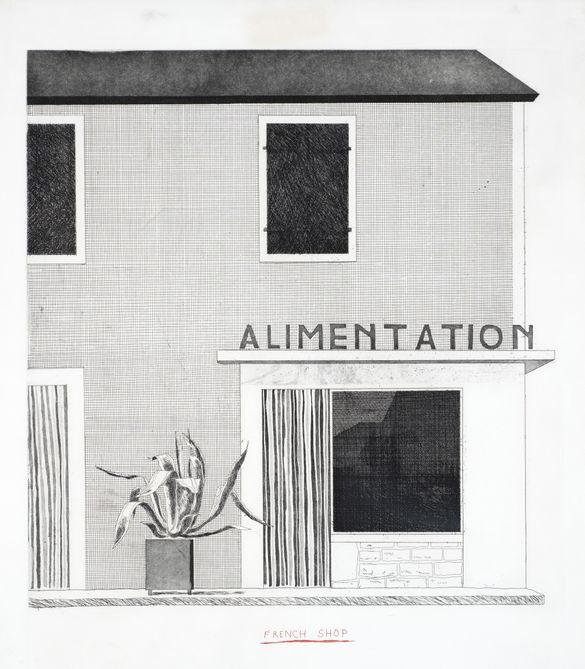
French Shop by David Hockney is a finely detailed etching that demonstrates the artist’s fascination with everyday architecture and ordinary settings. The work depicts a modest shop façade labeled “ALIMENTATION,” the French term for a general grocery store. Through his precise use of line, texture, and composition, Hockney transforms this simple subject into a visually engaging exploration of structure and detail.
The composition portrays a two-story building, its façade defined by a subtle grid texture. On the upper floor, two shuttered windows suggest an unused or closed-off space, while the ground floor prominently displays the shop’s name above a large window and adjacent doorway. In the foreground, a potted plant introduces an organic counterpoint to the clean, geometric lines of the architecture. A striped curtain partially obscures the shop’s interior, adding an air of intrigue and hinting at unseen activity beyond the building’s surface.
Hockney’s meticulous etching technique highlights the tactile and textural qualities of the architectural elements. The restrained monochromatic palette emphasises form and structure, reflecting the artist’s interest in capturing the quiet aesthetics of the everyday. This focus on simplicity and subtle detail is a recurring theme in Hockney’s work, where ordinary spaces are elevated to objects of contemplation.
By titling the work French Shop, Hockney situates the scene within a specific cultural context. However, its universal appeal lies in its familiarity, inviting viewers to connect with similar spaces in their own lives. The etching not only celebrates the understated beauty of an ordinary building but also encourages reflection on the unnoticed details that shape our surroundings.
Camden Art Collection
The London Borough of Camden Art Collection consists of just under 1,000 items that include works on paper, paintings and sculptures. The main focus of the collection is works dating from the late 1950s to the late 1980s, with many pieces by artists who lived in the Borough. Many of these works were inherited from the predecessor authorities who were gifted these pieces when the Council was established in 1965. Other works were directly purchased by the Council from 1965 to 1985, with limited funding from a ‘picture loan’ scheme that the Council operated.
Supporters