Claudia Jones
1915 - 1964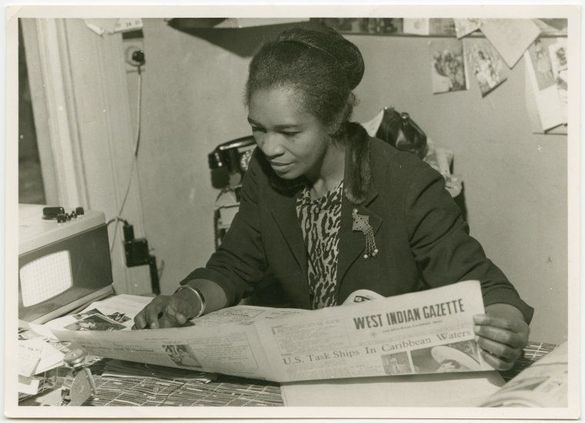
Claudia Jones
1915 - 1964
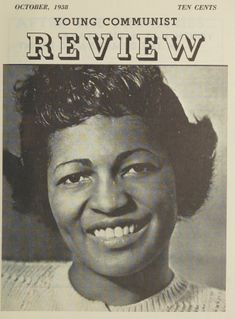
Claudia Jones was a pioneering human rights campaigner, political activist and journalist. In 1959 she organised the first Caribbean Carnival in London in Camden Town Hall, which at the time was called St Pancras Town Hall. This carnival led to the development of the Notting Hill Carnival that still thrives today.
Born Claudia Vera Cumberbatch in Trinidad on 21 February 1915, she was a descendant of people enslaved by the Cumberbatch family who worked the Cleland Estate and Farm in Barbados. When she was eight years old, her family moved to Harlem in New York City, USA in search of work. Despite encountering regular racism, Jones worked hard at school and was awarded the Theodore Roosevelt Award for Good Citizenship at her junior high school.
“My formal academic education on American soil began when I entered public school. I have early recollections of being hurt by youngsters of my own age who mouthed anti-West Indian propaganda against me and my sisters.”
Claudia Jones
At this time, Harlem was the centre of many American anti-racist movements, but the Black community there frequently faced oppression, racism and violence. Jones’ own family suffered poverty, poor living conditions and discrimination. Her mother’s early death at the age of 37 from exhaustion led Jones to ‘develop an understanding of the suffering of my people and my class and to look for a way to end them’.
At the age of 17 Jones developed tuberculosis as a result of her damp and poor housing conditions. She spent a year in hospital and the illness affected her for the rest of her life. During this time, she read a lot, and deeply considered racism, inequality and the struggles of women and the working classes. Seeing this suffering first hand led her to get involved in politics and activism in her late teens.
College and career opportunities for young Black women in America at this time were restricted. After high school, Jones worked in a series of low-paid jobs whilst developing skills in journalism. She wrote a column called ‘Claudia Comments’ for a Harlem paper, then joined the staff of communist newspaper The Daily Worker.
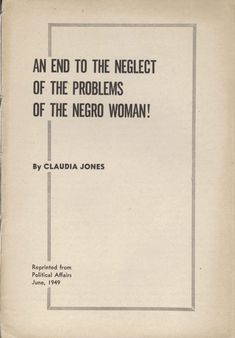
In her twenties Jones became editor of the Weekly Review and Spotlight, the political journal of the American Youth for Democracy. She used her writing to campaign against injustice. In 1949 she wrote her influential article ‘An End To the Neglect of the Problems of the Negro Woman!’ which described the oppressive treatment of Black women in America and called for a strong, organised movement to deliver equality and dignity.
“No peace can be obtained if any women, especially those who are oppressed and impoverished, are left out of the conversation.”
Claudia Jones
Claudia Jones’ Political Activism
Throughout her life, Claudia Jones was concerned with racism, gender and class discrimination. She fought against social injustice, speaking out against unfair policies and laws internationally. Jones also championed women’s rights.
In 1936 she joined the Communist Party of the USA and changed her surname to Jones as ‘self-protective disinformation’. She campaigned at rallies and events for equal pay and rights and fought against racism and oppression in America.
Her political activism, journalism and membership of the Communist Party made her an easy target for the FBI during the 1950s when anti-communist feeling in America was intense. From 1948 until her death Jones was under full surveillance by the FBI, who considered her activity as ‘un-American’. She believed that her outspoken opposition to the Korean War and criticism of the nuclear arms race led to her being arrested and imprisoned. She was classified as an ‘undesirable alien immigrant’ and was deported to Britain.
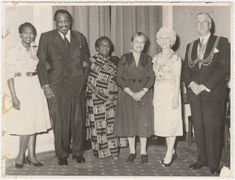
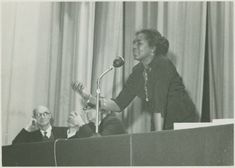
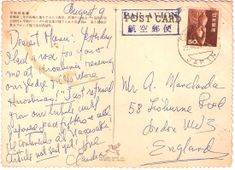
Jones arrived in London in December 1955, living in Lambeth and then Gospel Oak in Camden. She lived at 58 Lisburne Road with her partner, Indian political activist Abhimanyu Manchanda. She was part of a larger group of activists connected to Camden, including C L R James, Learie Constantine, Amy Ashwood Garvey and Paul Robeson, who made a speech at the African Freedom Meeting in this building in April 1959. Jones joined the Communist Party in Britain but was side lined and ignored by British Communists. Her vocal criticism of the racist and male-dominated structure in the Communist Party at this time was considered dangerous by those in positions of power.
Jones protested and opposed injustices over many years, campaigning for better jobs, housing, education and equal rights for Black people. She spoke out against the ‘colour bar’ preventing Black people from getting promoted at work, living in particular areas or joining certain societies.
Jones campaigned strongly against the racist Commonwealth Immigrants Act in 1962 arguing that it ‘established a second-class citizenship status for West Indians and other Afro-Asian peoples in Britain’. She put together political rallies and in 1963, organised a march on the US Embassy in London in support of Martin Luther King Jr and the Black American civil-rights movement. When King came to London in the following year, he met with Claudia Jones.
Claudia Jones’ work inspired many civil rights movements across the world and gave voice to the Caribbean community in Britain.
“She was a very warm person. There were lots of people around Claudia…the sort of person that in the Caribbean you could go and really pour your troubles to. It’s not that she probably had an answer for you, but talking about it was therapy enough.”
Donald Hinds
The West Indian Gazette and Caribbean Carnival
Claudia Jones’ work focussed on tackling inequality and racism. She founded Britain’s first Black newspaper, The West Indian Gazette, and put on Britain’s first Caribbean Carnival to enable people to share and celebrate culture.
‘A people’s art is their genesis.’ Claudia Jones, strapline to the Caribbean Carnival, 1959.
In London, Jones encountered widespread racism and discrimination against Britain’s Black communities. From the late 1940s British subjects from the Caribbean arrived in the UK to help rebuild the country after the ravages of World War II. Thousands of people with Caribbean heritage worked in emerging national services such as the NHS and the railways. Communities grew as people settled in London, but they faced extreme discrimination.
In response to this Claudia Jones set up Britain’s first major Black newspaper, the West Indian Gazette. The aim of the West Indian Gazette was to bring different groups within the Caribbean community together, share their experiences and have a voice. It presented articles on politics, the local and global struggle against racism, the arts, poetry, short stories and local viewpoints. The paper ran from 1958 until 1965.
“The newspaper has served as a catalyst, quickening the awareness, socially and politically, of West Indians, Afro-Asians and their friends. Its editorial stand is for a united, independent West Indies, full economic, social and political equality and respect for human dignity for West Indians and Afro-Asians in Britain, and for peace and friendship between all Commonwealth and world peoples.”
Claudia Jones on the West Indian Gazette, 1964.
In September 1958 racist attacks on the Caribbean community, known as the Notting Hill riots, escalated. Jones and her colleagues at the West Indian Gazette felt that the community needed something to show who they were and what they could give to British society. Jones said, ‘we need something to get the taste of Notting Hill out of our mouths,’ so she organised the first Caribbean Carnival to celebrate culture and have a moment to relax at a time when many people were living in fear.
The first Caribbean Carnival was held in Camden Town Hall (St Pancras Town Hall) in January 1959 and was televised by the BBC. The Carnival was directed by Edric Connor and featured steel bands, calypso singing, dancing, costumes, a beauty pageant and lots of food. The carnival was very successful and ran at venues across London for five years, eventually inspiring leaders to develop the Notting Hill Carnival, which now attracts around one million people every year.
“Claudia, unlike the rest of us, understood the power of culture as a tool of political resistance. The spirit of carnival came out of her political knowledge of what to touch at a particular time when we were scared, in disarray.”
Trevor Carter, activist, educator and stage manager of carnival, 1959.
Claudia Jones died at 59 Lisburne Road, Gospel Oak on Christmas Eve 1964, aged 49. She is buried at Highgate Cemetery to the left of Karl Marx. Jones left a lasting legacy and is known as one of the most influential Black leaders of post war Britain.
In 2023 the Claudia Jones Room, a community space in Camden Town Hall opened.
Supporters

